
From PPE Detection to Fire Monitoring: How AI Is Changing Industrial Safety Management
Executive Summary
Industrial environments face constant safety risks. Learn how AI video analytics uses existing CCTV cameras to identify PPE violations, detect smoke, monitor hazardous zones, and protect workers.
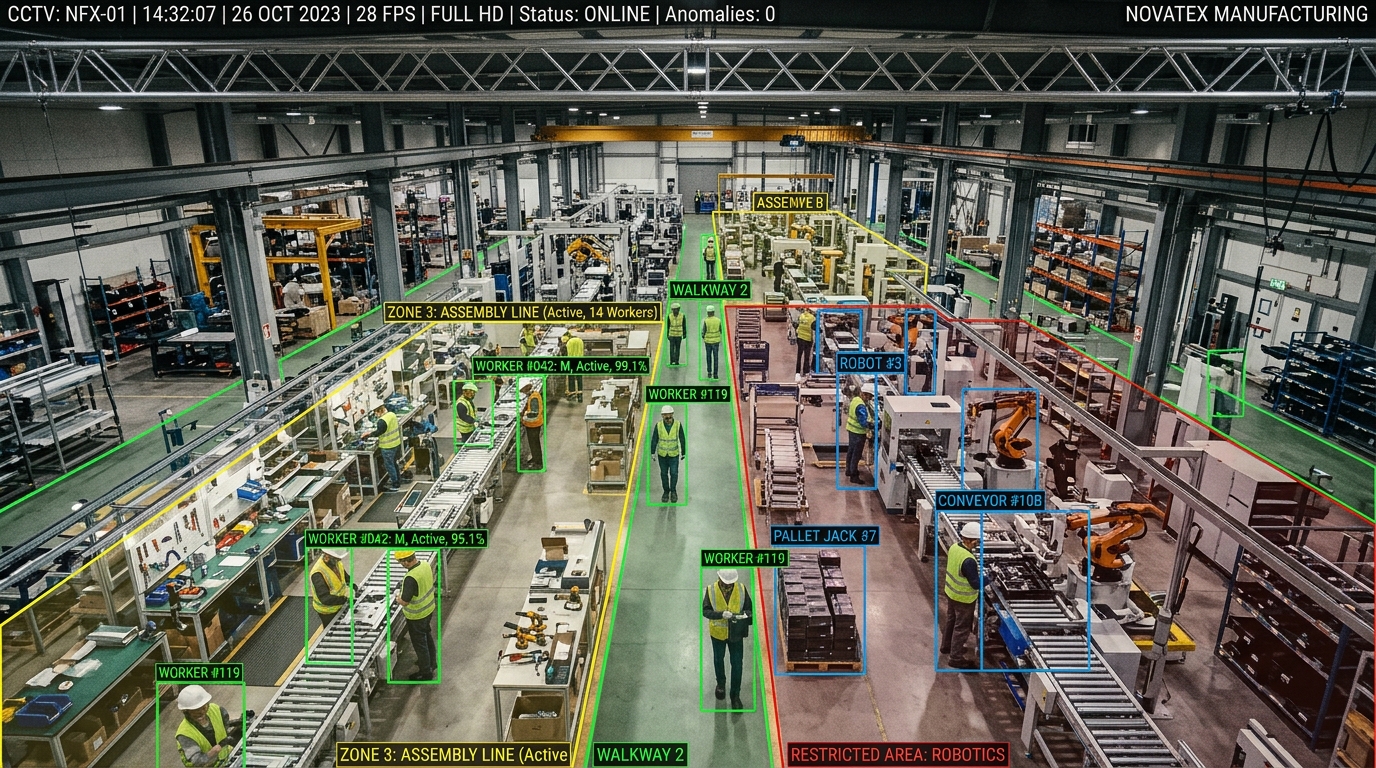
Industrial environments are built around productivity, precision and continuous operations. But behind every production line, warehouse floor and manufacturing facility are potential safety risks that require constant attention.
A worker entering a restricted area without authorization, an employee operating machinery without the required protective equipment, smoke developing near a production line or a person walking into a hazardous zone - these situations can quickly turn into serious workplace incidents if they go unnoticed.
Traditionally, industrial safety management has relied on physical inspections, manual supervision, safety personnel and CCTV monitoring. While these methods remain important, continuously monitoring every corner of a large industrial facility is a significant challenge.
This is where AI video analytics is changing the way industrial facilities approach workplace safety.
By using artificial intelligence and computer vision to analyse video feeds from CCTV cameras, businesses can identify potential safety violations, recognise visible hazards and generate alerts that help safety teams respond more effectively.
Let's explore how this technology is transforming industrial safety management.
1. Why Traditional Industrial Safety Monitoring Has Its Limitations
Manufacturing plants and industrial facilities often operate across multiple production areas, warehouses, machinery zones and loading docks.
Each area comes with its own safety requirements.
- Workers must wear appropriate personal protective equipment (PPE).
- Restricted areas must remain accessible only to authorised personnel.
- Fire and smoke hazards need immediate attention.
- Employees must maintain safe distances from operating machinery.
- Forklift routes and pedestrian pathways must remain properly managed.
Traditionally, supervisors and safety officers monitor these activities through periodic inspections and manual CCTV observation.
However, several challenges remain.
Continuous monitoring is difficult: A safety officer cannot physically observe every activity across an entire facility at all times.
Incidents can develop between inspections: Unsafe conditions may appear shortly after a scheduled inspection has been completed.
Manual CCTV monitoring requires attention: Monitoring multiple camera feeds simultaneously can make it difficult to notice every important event.
Safety violations can repeat: Without consistent visibility into recurring issues, identifying patterns across different shifts and departments becomes challenging.
The objective isn't to replace safety professionals. It's to give them better visibility into what's happening across their facilities.
2. PPE Detection: Monitoring Whether Workers Follow Safety Requirements
Personal Protective Equipment plays an important role in reducing workplace exposure to hazards.
Depending on the industrial environment, employees may be required to wear safety helmets, reflective jackets, gloves, protective eyewear, masks or other protective equipment.
But ensuring that everyone follows these requirements throughout every shift can be challenging.
How AI-powered PPE detection works
AI video analytics uses computer vision models to analyse CCTV footage and identify workers and visible protective equipment.
The system can be configured to recognise specific PPE items and identify situations where required equipment appears to be missing.
- A worker entering a production area without a safety helmet.
- An employee working in a designated zone without a reflective safety vest.
- A person entering an area without the required protective eyewear.
- Workers operating in designated areas without the specified protective gear.
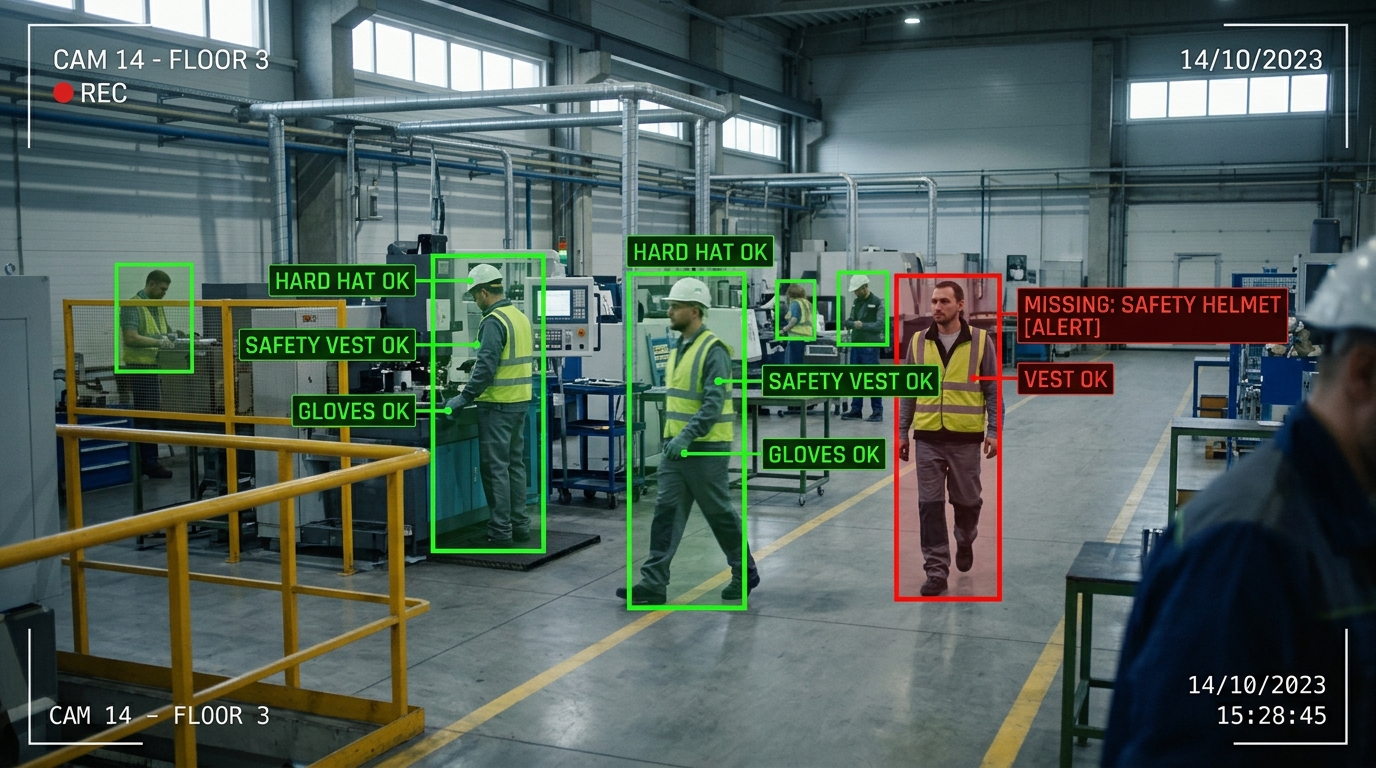
When a potential violation is detected, the system can generate an alert containing relevant information, such as the camera location, timestamp and detection snapshot.
Safety personnel can then review the event and take appropriate action.
Why this matters: Instead of depending entirely on periodic manual inspections, safety teams gain an additional way to monitor PPE compliance across different areas of a facility.
3. Fire and Smoke Detection: Identifying Visible Hazards Earlier
Fire is one of the most serious risks in industrial environments.
Electrical equipment, flammable materials, chemicals, machinery and high-temperature production processes can create conditions where fire-related incidents require immediate attention.
Even a small fire or developing smoke condition can become a major concern if it goes unnoticed.
Traditional fire detection systems, including smoke detectors, heat detectors and alarm systems, remain essential components of industrial fire protection.
AI video analytics adds another layer of visual monitoring.
How AI detects fire and smoke through CCTV
Computer vision models can analyse video feeds to identify visual patterns associated with flames and smoke.
- Visible flames near machinery or production equipment.
- Smoke developing in warehouse storage areas.
- Fire-related visual activity in electrical or utility rooms.
- Smoke appearing in designated industrial zones.
- Potential fire hazards in areas covered by existing CCTV cameras.
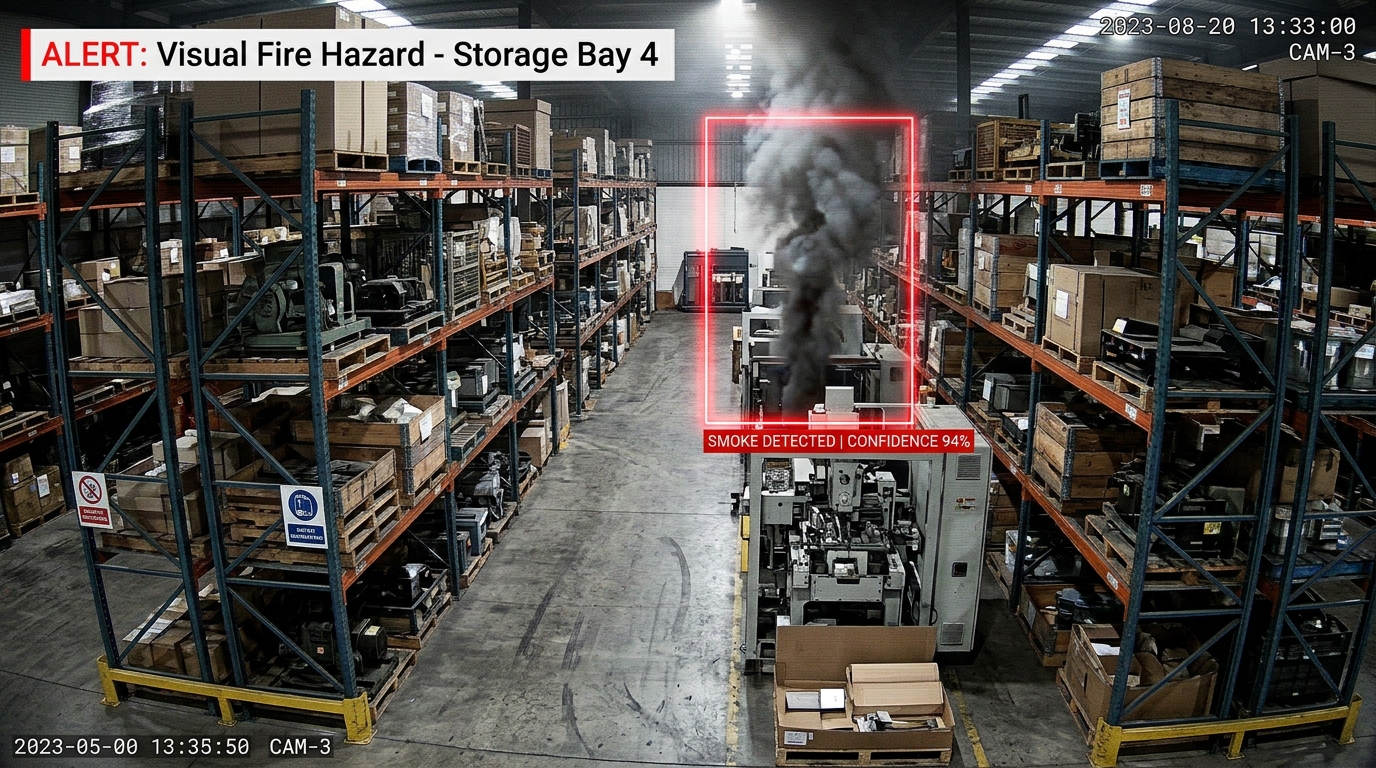
When the system identifies a possible event, it can generate an alert for the responsible safety personnel.
This provides an additional source of information that can help teams investigate potential incidents.
An important distinction: Camera-based fire and smoke analytics should complement certified fire detection and suppression systems, not replace them. Visual detection depends on camera placement, visibility, lighting and environmental conditions. Certified fire-safety equipment and established emergency procedures remain essential.
4. Restricted Area Monitoring: Preventing Unauthorised Access to Hazardous Zones
Industrial facilities often contain areas where access must be carefully controlled.
- Heavy machinery operating zones.
- Electrical substations.
- Chemical storage areas.
- High-temperature production sections.
- Hazardous material handling areas.
- Restricted maintenance zones.
An employee entering one of these areas without following the required safety procedures could be exposed to serious risks.
How AI-powered restricted area detection works
AI video analytics can monitor predefined areas within a camera's field of view.
When a person enters a configured restricted zone, the system can identify the entry and generate an alert.
For example, imagine a manufacturing facility where a particular section is reserved for authorised maintenance personnel.
If someone enters that area outside the permitted conditions, the system can flag the event for review.
This helps safety teams maintain better visibility into restricted-area activity without relying exclusively on someone watching the camera continuously.
5. Unsafe Proximity to Machinery: Monitoring People Around Moving Equipment
Heavy machinery is an essential part of manufacturing operations, but working around moving equipment requires strict safety procedures.
Industrial environments may contain robotic arms, conveyor belts, automated production lines, cutting equipment and heavy machinery.
Workers operating too close to moving equipment or entering designated danger zones may be exposed to potential injuries.
AI video analytics can help monitor these environments through:
- Zone intrusion detection: Recognising when a person enters a predefined hazardous area.
- Proximity monitoring: Identifying potential unsafe proximity between people and machinery where the camera view and configured analytics support it.
- Activity monitoring: Flagging specific visual events that safety teams have configured the system to recognise.
For example, a facility can configure a virtual boundary around a particular machinery area. If a person enters that boundary under monitored conditions, the system can generate an alert.
These capabilities provide additional visibility into potential safety risks and support existing machinery safeguarding procedures.
6. Fall Detection: Identifying Potential Worker Falls
Falls are a serious concern in industrial workplaces, particularly in environments involving elevated platforms, stairs, slippery floors and physically demanding activities.
In large facilities, a worker falling in an isolated section may not immediately come to the attention of nearby supervisors.
AI-powered fall detection can analyse video footage to identify visual patterns associated with a person falling.
- Detecting a person falling in a production area.
- Identifying potential falls in warehouse spaces.
- Monitoring designated high-risk work zones.
- Generating alerts when a possible fall event is detected.
The system can notify the responsible personnel so that they can investigate and respond.
However, fall detection should be understood as an alerting capability, not a guarantee that every fall will be identified. Camera angles, occlusion, lighting and the nature of the movement can affect detection.
7. Forklift and Pedestrian Safety: Reducing Risks in Busy Industrial Facilities
Warehouses and manufacturing facilities frequently use forklifts and other industrial vehicles to transport materials.
When pedestrian movement and vehicle movement overlap, the potential for accidents increases.
Blind spots, narrow pathways, loading areas and busy intersections can make these environments particularly challenging.
- Person detection in designated vehicle operating zones.
- Forklift and industrial vehicle detection.
- Pedestrian intrusion into restricted vehicle pathways.
- Monitoring activity around loading and unloading areas.
- Identifying potential unsafe interactions between people and vehicles.
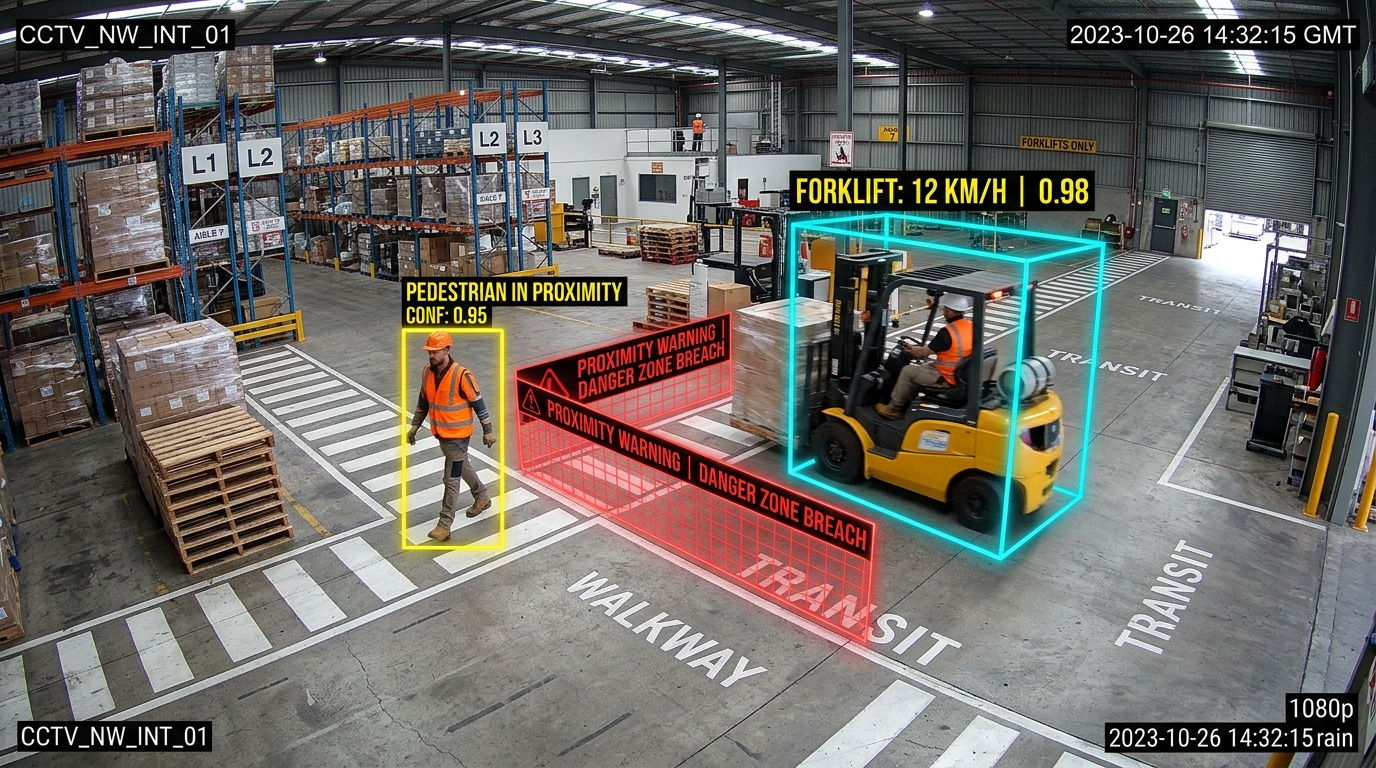
For instance, a camera monitoring a forklift route can be configured to identify when a pedestrian enters a designated vehicle movement zone.
The system can then generate an alert for the responsible personnel.
This helps industrial facilities improve visibility into vehicle and pedestrian movement while supporting existing traffic management and safety procedures.
8. How Multiple AI Safety Detections Work Together
One of the biggest advantages of AI video analytics is that industrial facilities do not necessarily need to approach every safety concern as an isolated monitoring activity.
Multiple detection capabilities can work across different camera feeds and facility areas.
Consider a manufacturing facility with the following requirements:
| Facility area | AI monitoring capability |
|---|---|
| Production floor | PPE detection |
| Machinery section | Restricted zone monitoring |
| Warehouse | Person and vehicle detection |
| Electrical room | Visual fire and smoke detection |
| Loading dock | Forklift and pedestrian monitoring |
| Worker access areas | Person detection and entry monitoring |
Instead of depending entirely on separate manual observations, the facility can use AI-assisted monitoring to identify configured events across multiple locations.
When a potential incident is detected, the system can generate relevant alerts and provide visual evidence for review.
This creates a more connected approach to industrial safety monitoring.
9. From Detection to Alerts: Why Incident Response Matters
Identifying a potential safety violation is only one part of the process. What happens after the detection is equally important.
Imagine a system identifying smoke in a warehouse storage area. If the information never reaches the responsible personnel, the detection alone does not solve the problem.
This is why alert management and incident response workflows are important components of an AI-powered safety solution.
A typical workflow may look like this: 1. Video analysis: AI continuously analyses configured CCTV feeds. 2. Event detection: The system identifies a potential safety violation or visual hazard. 3. Alert generation: Relevant information, such as the camera location, timestamp and snapshot, is generated. 4. Notification: The appropriate safety personnel receive an alert through the configured communication channel. 5. Verification: The responsible team reviews the event and determines whether action is required. 6. Response: The team follows established safety and emergency procedures.
This approach helps connect visual detection with the people responsible for workplace safety.
10. How Zaylix Supports Smarter Industrial Safety Management
At Zaylix, we believe existing video infrastructure can do much more than record what happens inside an industrial facility.
Our AI video analytics platform uses computer vision to help businesses gain better visibility into their environments through existing CCTV infrastructure.
Rather than treating cameras as passive recording devices, Zaylix helps transform their video feeds into sources of actionable visual intelligence.
- PPE Detection: Identify visible safety equipment and flag potential PPE compliance violations in configured camera views.
- Person Detection: Identify people across monitored areas and support other safety-related detection workflows.
- Fire and Smoke Detection: Identify visible fire and smoke patterns through suitable CCTV feeds and generate alerts for potential incidents.
- Restricted Area Detection: Monitor predefined zones and identify potential unauthorised or unsafe entries.
- Vehicle Detection: Identify vehicles within monitored industrial environments and support vehicle-related safety monitoring.
- Fall Detection: Identify visual patterns associated with potential falls and alert the responsible personnel.
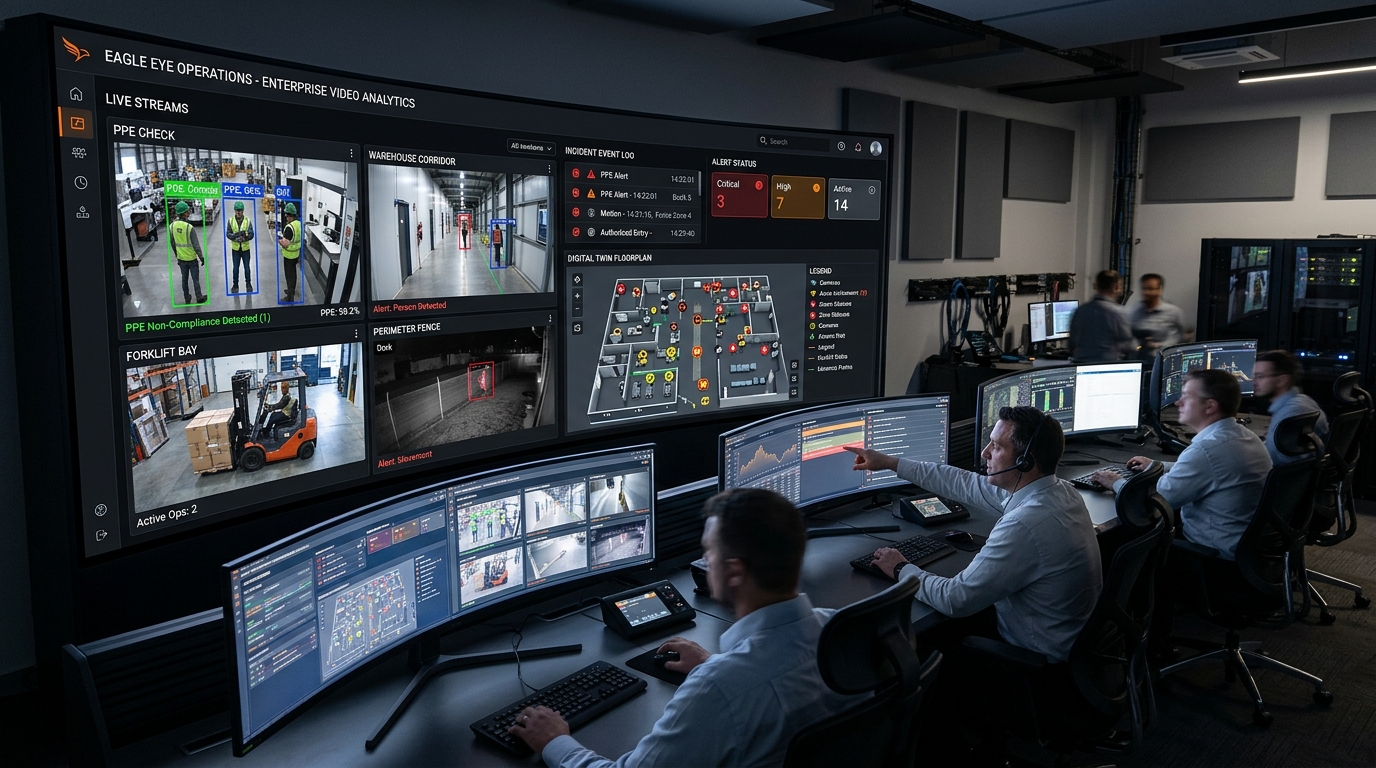
These capabilities can be configured according to the requirements of individual facilities. Zaylix also supports a broader approach to video intelligence through features such as centralised monitoring, digital twin visualisation, alert workflows and integrations.
The objective is to help businesses move towards more intelligent, connected and responsive facility operations.
11. Can Industrial Facilities Use AI Video Analytics With Their Existing CCTV Cameras?
One common concern businesses have when considering AI video analytics is whether they need to replace their entire CCTV infrastructure.
In many cases, they don't.
AI video analytics platforms can integrate with compatible existing camera feeds, allowing businesses to explore intelligent monitoring without automatically investing in an entirely new camera network.
- Camera resolution and video quality.
- Camera placement and viewing angle.
- Lighting conditions.
- Distance between the camera and monitored objects.
- Occlusion caused by machinery, structures or other objects.
- Network connectivity and video stream availability.
- The specific detection capability being implemented.
For example, a camera positioned too far away may not provide sufficient detail for reliable PPE detection. Similarly, a camera with an obstructed view may not be suitable for monitoring a particular restricted area.
This is why evaluating camera feeds and testing relevant use cases before deployment is important.
At Zaylix, businesses can explore a Proof of Concept (POC) to assess the suitability of their existing camera infrastructure and understand how selected AI video analytics capabilities could support their operational requirements.
12. The Future of Industrial Safety Is Intelligent, Connected and Proactive
Industrial safety management is evolving. As manufacturing facilities become more automated and industrial operations become increasingly complex, businesses need better ways to understand what is happening across their environments.
AI video analytics offers an additional layer of visibility by helping identify potential safety violations, recognise visual hazards and connect detections with alert and response workflows.
From PPE compliance and fire and smoke monitoring to restricted-area detection, fall detection and forklift safety, computer vision is creating new possibilities for industrial safety management.
However, technology works best when it supports strong safety practices, trained personnel, appropriate engineering controls and established emergency procedures. The goal isn't simply to detect more events. It's to help the right people become aware of important situations and respond appropriately.
With Zaylix, your existing CCTV infrastructure can become a foundation for smarter industrial video intelligence.
Ready to Explore AI Video Analytics for Your Industrial Facility?
Your cameras may already be capturing important information about your facility. The next step is making that information more useful.
Explore how Zaylix can help your business introduce AI-powered safety monitoring using compatible existing CCTV infrastructure.
Request a Free Proof of Concept (POC) and discover how AI video analytics can support safer, smarter industrial operations.