
PPE & Safety Compliance Detection
Catch missing PPE before it becomes an incident.
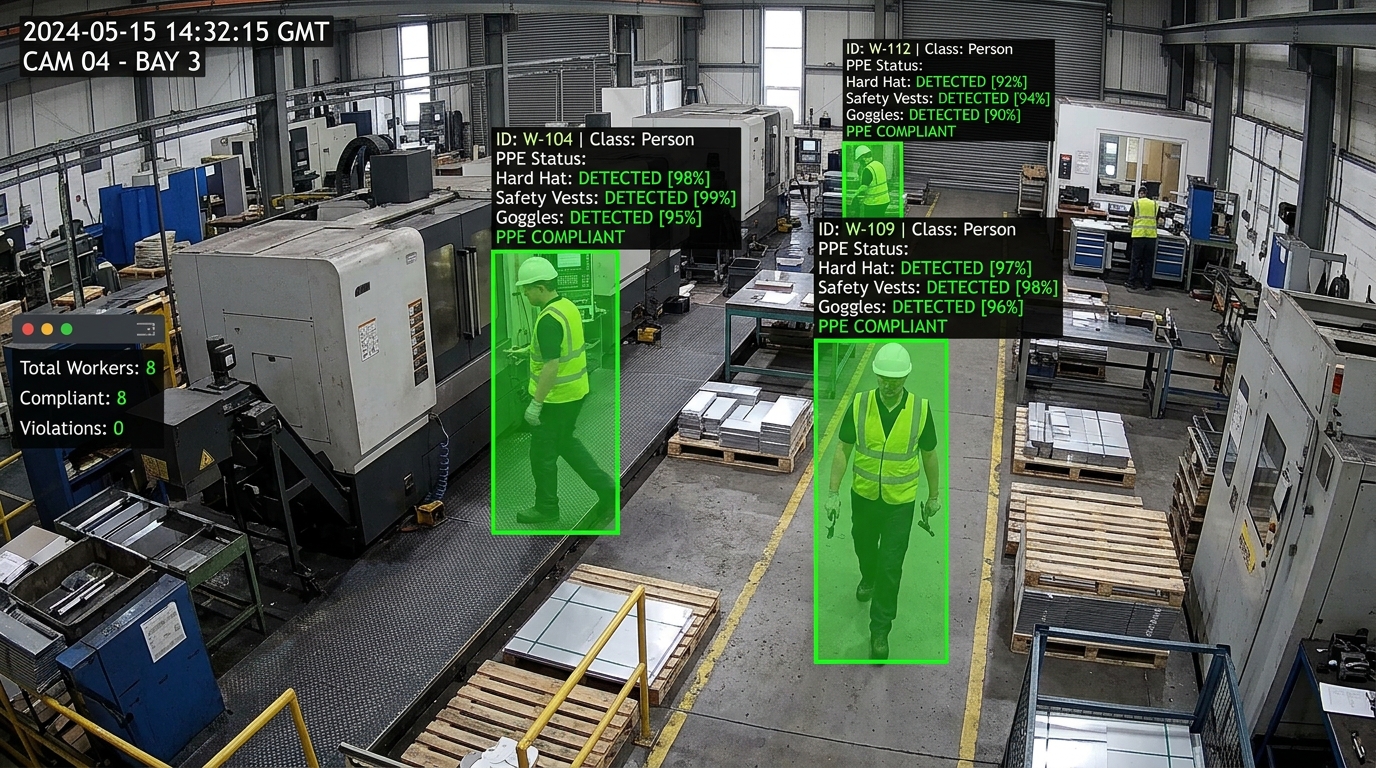
Zaylix watches your existing site cameras for hard hats, hi-vis vests, gloves, harnesses and other required PPE, and flags a violation the moment it happens, not after an inspection or an injury report.
Operational Challenge & How Zaylix Solves It
Moving from reactive surveillance footage review to automated real-time operational response.
Current Friction & Risks
Manual safety walks catch a fraction of what's happening on a site at any given moment. By the time a violation shows up in a weekly report, it's already happened, possibly many times. Sites with dozens of workers across multiple zones can't have a supervisor watching every camera, every shift.
How We Solve It
- Runs on the cameras already installed at your site, nothing to buy or mount.
- Detects missing hard hats, vests, gloves, harnesses and other configurable PPE per zone.
- Flags are human-verified before they reach you, so you're not chasing false positives.
- Each alert includes the camera, zone and timestamp, so it's usable as compliance evidence.
How It Actually Works
What runs behind the alert, what your cameras need, and where the honest limits are.
How detection works
Zaylix connects to the cameras covering each zone over RTSP or ONVIF, the standard streaming protocols most commercial CCTV and NVRs already support. Detection models run continuously on the live stream, checking each person in frame against the PPE rules configured for that specific zone, a loading dock might require a hi-vis vest and hard hat, while an office camera next to it checks nothing. When the model flags a likely violation, a human reviewer checks the clip before any alert goes out, which is what keeps the system from flooding you with false alarms over a cap that looks like a hard hat from one angle. The verified alert then reaches whoever's responsible, by app, SMS, call, or into your own systems via webhook, with the camera, zone and timestamp attached so it's usable as compliance evidence.
What your cameras need
- An IP camera or NVR that streams over RTSP or ONVIF, which covers most commercial CCTV installed in the last 10-15 years.
- A mounting angle and resolution that actually resolves a hard hat or vest at the distance workers typically stand from the camera. A wide, high-up overview camera often isn't enough on its own; we check this per camera, not after a contract is signed.
- Reasonable lighting for the zone. Dim loading docks or night shifts may need IR-capable cameras or added lighting, which we'll flag during the review if it's a real problem.
- A stable network path from the camera or NVR to wherever detection runs.
What it can't do
- We don't sell or install cameras. If your existing setup genuinely can't support reliable PPE detection on a given zone (too far, too dark, wrong angle), we say so in the feasibility review instead of deploying something that won't work.
- Human verification adds a short delay between the detection and the alert reaching you, not instant AI-only alerting. That's intentional, to cut false positives, but worth knowing if you need true sub-second automated response.
- It's early-stage technology: tested models and POC footage, no completed independently-owned live deployment yet. We say this upfront, and the free pilot exists so you can verify fit before committing.
- It detects PPE presence and zone compliance, not identity. No facial recognition is used to tie a violation to a named individual.
Designed for Critical Operations
This solution integrates seamlessly across multiple high-stakes commercial and industrial settings.
Manufacturing & Plant Operations
On the factory floor, a missed hazard is a shutdown or an injury. Zaylix turns every line camera into a safety, security and inventory sensor, flagging violations the instant they happen.
Warehousing
Stock walks, forklifts collide, docks sit unwatched. Zaylix counts inventory to 99%+ accuracy and keeps eyes on every aisle, gate and dock, around the clock.
Logistics & Supply Chain
Throughput lives and dies at the gate and the yard. Zaylix automates access, tracks vehicle movement and secures cargo across sites, surfaced in one Digital Twin.
Other Detection Types
Zaylix runs multiple detection types on the same cameras at once.
Technical & Deployment Clarity
Got questions about edge hardware, setup, or accuracy? Here are direct answers.
Do we need to buy new cameras for PPE detection?
No. Zaylix runs its detection models on the CCTV you already have, as long as the camera resolution and mounting angle are workable. We confirm this in a free feasibility review before anything is deployed.
Can it tell the difference between zones that require PPE and ones that don't?
Yes, detection zones are configured per camera, so an office or break-room camera isn't flagging the same rules as a shop floor or active construction zone.
Do you have a completed PPE detection deployment we can see?
We are early-stage and honest about it: we have tested, working detection models and POC footage, but no completed live client deployment yet. We offer a free feasibility review and can run a short pilot on your own cameras.
What counts as PPE in the detection rules?
Hard hats, hi-vis vests or jackets, gloves, safety harnesses, and eye or face protection are the common ones. Which items are checked, and in which zones, is configured per site, not a fixed list.
Can it tell a hard hat apart from a regular cap or hood?
Yes, that's the core detection task, distinguishing compliant PPE from similar-looking non-PPE items like caps, hoods or bare heads. Accuracy depends on camera angle and resolution, which is exactly what the feasibility review checks before anything is deployed.
Does this replace our safety officer or manual walks?
No. It's built to catch what a safety officer physically can't watch every minute of, across every camera, every shift. Manual walks and safety culture still matter; this closes the gap between walks.
How fast is an alert after a violation happens?
Detection happens as the event occurs. The alert goes out after a quick human verification step, which is a deliberate delay of moments, not hours, to cut false positives before they reach you.